A mature tree planted on the property enhances the property’s aesthetics, provides shade, and improves its value. However, even the healthiest of the trees has a specific lifespan. If you notice that a tree hasn’t produced a full canopy by the end of summer, or if the tree is exhibiting extensive dieback, then it is a sign of serious decline in the tree.
Ignoring the signs will increase the risks of falling branches, potentially leading to expensive property damage.
Are you wondering whether it’s time for tree removal in Edmonton? Then knowing the signs of decline can help you make an informed decision.
What are the signs of a dying tree?
Are your trees struggling? Do they need to be removed? Not every struggling tree needs to be removed. However, look for symptoms of recovery. If the tree doesn’t exhibit any sign of recovery, then these are signs of a dying tree.
Extensive upper canopy dieback
Extensive upper canopy dieback is one of the clearest indicators of tree decline. In this situation, the branches become bare, brittle and lifeless. The dead branches make the tree look like a skeleton. This indicates that the tree is no longer able to support healthy growth. Again, if more than half of the tree’s canopy has dead branches, the tree’s health has deteriorated beyond recovery.
Bark peeling and large cracks
If the bark of the tree is healthy, then it will protect the tree from pest infestation. However, the bark of the tree starts peeling away in large sections, and if the cracks appear on the trunk, then you can consider them as signals of internal tree damage. This weakens the tree’s structure and makes it vulnerable. These trees might fall during storms and cannot withstand strong winds.
Mushrooms and fungal growth
If you notice mushrooms and other fungal growth around the bases of trees and trunks, it is a sign of root decay. A rotten root compromises the tree’s overall stability and makes it vulnerable.
Decision matrix – save it or remove it?
Making the decision to save or remove a tree is challenging, since there’s sentimental value attached to every tree. You need to consider three key factors to assess the condition.
Risk
How close is the tree to your property? Does it pose a hazard to the driveway, power lines, or areas where people regularly gather? If yes, then the tree should be removed to prevent accidents.
Cost
Most of the time, trees are restored through pruning, pest control and improved tree care. However, if the tree is damaged beyond repair, the 50% rule applies. For instance, if more than 50% of the tree is dead or damaged, the professionals consider complete removal the most feasible option.
Sentiment
If you’re emotionally attached to the tree, then a healthy replacement can help you preserve the landscape without unnecessary risks.
How do professionals safely remove declining trees?
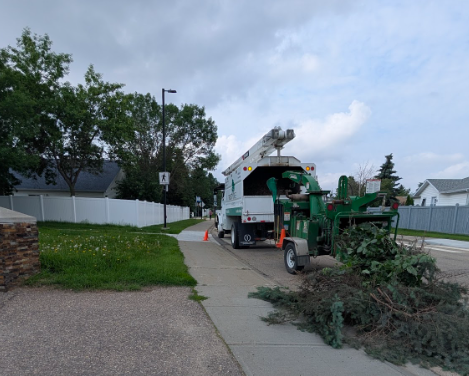
Specialized equipment is required for the removal of large trees. Professional tree surgeons prefer sectional dismantling instead of felling the entire tree at once. This involves careful removal of the branches and trunk sections one piece at a time.
This is a safe, controlled method for tree removal in Edmonton, performed by experienced specialists.
Why is stump grinding used to complete the job?
Once the tree has been removed, the stump remains, which becomes an obstacle. If not removed, they attract insects and decay over time. Stump grinding is the process of removing all visible stumps below ground level. This helps leave a clean surface in the ground for planting grass and flowers. This is the final step necessary to improve the appearance and usability of the yard.
Do not wait until it’s too late
If you’ve a declining or damaged tree in your backyard, do not hold back. Act promptly and call a professional tree surgeon to remove it. This will help you protect the landscape and the property.
Unsure about a dying tree? Get an honest assessment and a free quote for removal from Trusty Tree Services.
📞 Call us for a free estimate 780.860.5500
🔗 Visit our website to learn more https://trustytree.ca/
Trusty Tree Services supports municipal and utility projects while delivering safe, efficient tree care to industrial, commercial, and residential clients in the Edmonton and surrounding area.
Related Articles
Follow Us on Social Media
Stay updated with our latest news and tips by following us on Facebook and Instagram